
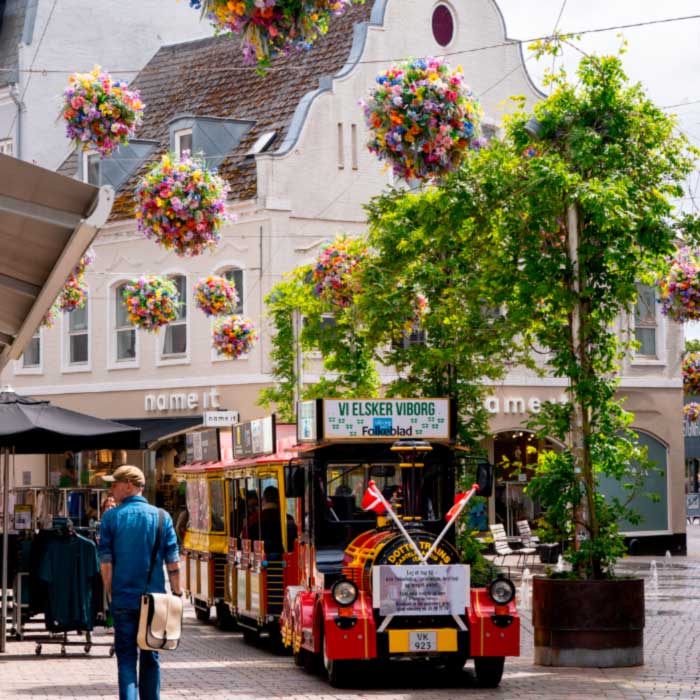
A train excursion through Viborg
Hop on the city train and enjoy a pleasant ride through the pedestrian streets and the old town.
Summer:
Friday 19 June – Saturday 22 August
Departure from Hjultorvet:
Monday–Friday: 1:00 PM – 2:15 PM – 3:15 PM – 4:15 PM
Saturday: 12:00 PM – 1:15 PM
Departure from Borgvold:
Monday–Friday: 1:30 PM – 2:40 PM – 3:45 PM – 4:45 PM
Saturday: 12:30 PM – 1:45 PM
The tour takes approximately 1 hour.
Please note that routes may change due to roadworks, etc.
Ticket prices: Adults: 60 DKK / Children (4–12 years): 40 DKK
Halloween:
Friday, October 2, the train runs in the pedestrian streets from 3:00 PM – 9:00 PM
Free of charge.
Departures from Hjultorvet.
Autumn Holiday:
Friday, 9 October – Saturday, 17 October
Weekdays: 1:00 PM – 5:00 PM
Saturdays: 10:00 AM – 2:00 PM
Departures from Hjultorvet every 15 minutes.
Ticket price: 20 DKK
Children under 4 travel free.
A Train Excursion Through Viborg
By Bymanden
Dear Guests,
You are about to embark on a unique train journey through the past, the present and the future, exploring medieval Viborg, the historic trading town and the city by the lakes. No other town offers such a diverse blend of history, culture and natural beauty. Enjoy your journey!
1: Hjultorvet
Hjultorvet is the central square in Viborg. From here, tradesmen sold their goods from horse-drawn wagons. Before the Reformation, both a cemetery and the Church of Sct. Mathias were located here. Today, the large and beautiful building on Hjultorvet houses one of Viborg’s many banks.
2: St. Sct. Mikkels Gade
St. Sct. Mikkels Gade is a typical medieval street – narrow and very steep. Like many of Viborg’s old streets, it is named after a church, Sct. Mikkels Kirke. The church was situated just outside the town gate and provided shelter for the sick and the poor.
3: Sct. Kjelds Brønd
On the right, you will see the well known as Sct. Kjelds Brønd. It is named after the Catholic saint Kjeld. Here, market women could wash and clean their produce during market days.
4: Nytorv
During the Catholic period, Viborg’s oldest parish church, Sct. Hans Church, stood here. The church and its cemetery prevented the medieval town from expanding into this area. It was also here that Danish kings were acclaimed. At that time, Viborg played a prestigious role in Danish society. A king could not be recognised without travelling to Viborg and being acclaimed by the free men at the Viborg Assembly. Thus, Nytorv became the setting for the acclamation of a six-year-old prince. Following the ceremony, the square was used as a marketplace. Since 2017, the market has returned and is held here every Saturday during the summer.
On the left is the Chemist’s Courtyard. For almost 400 years, it was home to Viborg’s oldest continuously operating business, Svaneapoteket, founded in 1573. Embedded in the pavement is the town’s “0-kilometre stone”, marking the geographical centre of Viborg. When Viborg Municipality recently renovated Nytorv, archaeologists first had to remove 643 skeletons. The former medieval cemetery has now been brought back to life with cafés, restaurants and market activities, and the weekly market is once again held here every Saturday morning.
5: Kompagnistræde
The train now takes you down Kompagnistræde. The street’s name might suggest that Viborg was home to military companies for many years, but it more likely refers to a group of wealthy investors who joined together and built Kompagnigården. Behind the wall, you will find one of Viborg’s charming green spaces, Latinerhaven. Before the great fire of 1726, three manor houses stood here. They were never rebuilt after the fire, and the area was instead given to the Latin School as a garden – hence the name. When the school later moved, the garden was transferred to the town.
6: Sct. Mogens Gade
Sct. Mogens Gade oozes history. Here, many of the old houses still stand close together, creating a unique atmosphere. Behind the red brick wall with its beautiful wrought-iron gate, you will find the idyllic Museum Garden, where you can enjoy a peaceful break. In earlier times, this garden was reserved exclusively for prisoners from the adjacent jail.
7: Gammeltorv
This square has witnessed more than 1,000 years of history and is the oldest public square in Viborg. The cathedral, Viborg Domkirke, the court and the markets attracted visitors from across the country. The Baroque building on the square houses Skovgaard Museet, an art museum that offers insight into the life and work of the Skovgaard family, as well as an impressive collection of Danish graphic art.
8: Viborg Cathedral and the Bishop’s Palace
Viborg Cathedral, with its twin towers, is the symbol of the city. The cathedral dates back to the 12th century, but after several devastating fires – the most recent in 1726 – only the crypt of the original cathedral remains. The present cathedral is approximately 150 years old and was designed to recreate the appearance of the medieval cathedral. The large monument to the left of the cathedral commemorates the close relationship between the Danish Air Force and Viborg Cathedral, which serves as the Air Force church. Notice the two lions and the carved heads behind them. These are relics from the original cathedral.
The interior of the cathedral is particularly famous for Joakim Skovgaard’s colourful frescoes, which cover the walls and vaults with scenes from the Bible. On the right side of the cathedral stands Bispegården, the Bishop’s Palace. It is Denmark’s oldest episcopal residence and has been home to the Bishops of Viborg since 1555.
In addition to serving as the bishop’s residence, it houses the administration of the diocese and its library, which is the oldest public library in Jutland.
9: The Parish Community Centre
The yellow building is Viborg Parish Community Centre, established in 1997. The large monument is a memorial to the ancient assemblies held in Viborg. At this site, Danish kings were acclaimed for more than 600 years. Behind the trees, you can see the memorial dedicated to the local victims of the Second World War.
10: Sct. Mathias Gade
Back on Sct. Mathias Gade, we travel down the steep hill towards the Viborg Lakes and Borgvold. During the late Middle Ages, one of Viborg’s five city gates stood here. At that time, Sct. Mogens Gade and Sct. Mathias Gade were the city’s two main streets. Many of the largest and most impressive noble and merchant houses were located here, although many were destroyed in the great fire of 1726. With the construction of the bridge, the dam and the new Randers Road in 1852, traffic shifted to Sct. Mathias Gade. Its importance increased even further when the railway station opened in 1896, making Sct. Mathias Gate a major transport hub.
11: Sct. Ibs Gade
Sct. Ibs Gade is another of Viborg’s streets named after a Catholic saint. The street takes its name from Saint James the Greater – known in Danish as Ib – who was the first of Christ’s apostles to suffer martyrdom. From his shrine in Santiago de Compostela in Spain, pilgrims brought home the famous scallop shells, which became known as Saint James’s shells. The large red building is a former residential care home, originally built in 1919. It has been extended and modernised several times over the years. A few years ago, the institution closed and was converted into private apartments.
12: Borgvold Park
Borgvold Park was established in 1864 when the local distiller David Haubro and his wife Kristiane donated their meadow to the city for the creation of a public park. In return, the authorities agreed to maintain the couple’s burial site for as long as the cemetery exists. Since then, the park has been redesigned and expanded several times.
The park takes its name from the 12-metre-high hill on your left. At its summit, King Erik Menved (reigned 1286–1319) built a castle following a peasant uprising. The castle was intended as a symbol of royal authority. To supply water to the castle moat, the water level of both lakes was raised by two metres. As a consequence, the oldest part of Viborg, a merchants’ quarter northwest of Søndersø, was flooded.
13: Borgvold Highlights
The fountain is called The Water Girl and was created by the German sculptor Ludwig von Schwanthaler. Humorous locals often refer to it as The Iron Lady. It was placed in Borgvold in 1948 as a gift from the former judge Frants Thygesen. The music pavilion was rebuilt in 2008 and is frequently used for concerts and other events during the summer months. The white building nearby is the third structure to stand on this site. The first was built in 1867 but was destroyed by fire during the Second World War in 1943. It was replaced by a new building in 1956. Golf Salonen, part of Golf Hotel Viborg, serves as both a restaurant and a conference centre.
14: The Tour Boat “Margrethe I”
The boat arrived on the Viborg Lakes in 1990. The Roman numeral I was added not only to emphasise the boat’s premier status on the lakes, but also because of Viborg’s close historical connection with Queen Margrethe I, ruler of the Nordic kingdoms. A tour of the lakes takes approximately one hour and includes both Søndersø and Nørresø.
15: Hans Tausens Allé
Before leaving Borgvold, you will see the Bible Garden in the south-western corner of the park. For more than 1,000 years, Viborg has been an important religious centre, making it a natural location for Denmark’s first Bible Garden. The city gardener at the time, Jacques Gustin, established the garden in 1989 with private funding.
The garden contains a unique collection of herbs, bushes and trees, all of which are mentioned in either the Old or the New Testament. On the opposite side of the road stands The Distillery. It operated as a distillery from 1811 to 1876. The building is one of Viborg’s original manor houses. Purchased by the local authorities in 1992 and carefully restored, it now serves as a cultural centre hosting changing art exhibitions and art workshops.
16: Sct. Mathias Gade
Up we go again!
As we continue along Sct. Mathias Gade, you will see Viborg Hallen, built on the site where the town’s first private residence with its own garden once stood. Across the street is Brygger Bauers Grotter. The former storage cellars of the Dania Brewery have been transformed into one of Viborg’s most distinctive restaurants.
Inside the restaurant, a small spring known as Sct. Mathias Well still flows through the caves.
17: Sct. Leonis Gade
Here you will find the oldest secular residence in Viborg, which today serves as the home of the Dean of Viborg. The building dates back to the 15th century and was, for a period, used as a women's prison.
18: Ll. Sct. Mikkels Gade
The street is named after Sct. Mikkels Church, which once stood on the eastern side of the street. The site now occupied by the restaurant Tortilla Flats was formerly home to another church, Sct. Stefan’s Church. In the 17th century, the church was replaced by a dye works. In 1904, the property was purchased by the municipality and converted into a nursing home.
19: St. Sct. Mikkels Gade
The Odin Brewery was located in the red building. Brewing began in 1832 and continued until 1988, when the brewery closed. Along this street you will also find Sortebrødre Kirke, one of Viborg’s oldest churches. The church is beautifully decorated and features a unique pre-Reformation altarpiece donated by King Frederik IV after the great fire of 1726. Originally, the church formed part of a large monastic complex belonging to the Dominican Order.
20: St. Sct. Peder Stræde
The beautiful half-timbered building on the right was once a blacksmith’s workshop. Today, it houses one of Viborg’s most popular restaurants, Den Gyldne Okse. Further along the street, near Sydbank, stood one of Viborg’s many monasteries: the Budolfi Nunnery. Remarkably, the convent survived the Reformation but was later demolished because of increasing traffic through the street.
21: Sct. Mathias Gade
We are now entering Sct. Mathias Gade, Viborg’s main pedestrian shopping street. Here, shops stand side by side, ranging from small independent speciality stores with their own distinctive character to well-known chain stores whose appearance is familiar throughout Denmark. On the left stands Sct. Mathias Centret, a shopping centre with 32 shops and four eateries, offering a warm welcome should you be caught in the rain.
22: Sct. Mathias Port
The entrance to the pedestrian zone is known as Sct. Mathias Port. During the Middle Ages, one of Viborg’s five city gates stood here. Notice the distinctive paving, which combines newly cut granite with reused historic stones.
23: Gravene
For many years, Gravene carried heavy traffic from one of Denmark’s major highways. The junction where Gravene meets Sct. Mathias Gade was once one of the busiest traffic intersections in Jutland. Today, it is difficult to imagine the volume of traffic that once passed through this historic part of the city.
24: Trappetorvet
Trappetorvet is one of Viborg’s most distinctive urban spaces. The square was deliberately designed as a flexible public area suitable for concerts, performances, exhibitions and public events. Its broad steps, inspired by Spanish architecture, are constructed from granite and feature a water sculpture created by the artist Sergei Sviatchenko.
Located in the very heart of Viborg, Trappetorvet remains an important gathering place for residents and visitors alike.
25: Gravene
The beautiful red building on the corner is Viborg Theatre, designed by Søren Vig-Nielsen and completed in 1909. The adjoining cultural complex consists of two sections. One part is occupied by Viborg School of Music, while the other contains the large concert hall, owned and operated by Viborg Municipality. The concert hall was inaugurated on 16 March 2002 and seats 270 guests. Founded in 1979, Viborg School of Music employs around 40 teachers and provides music education for approximately 1,000 students. With its yellow walls and red tiled roof, the Old Guardhouse is a fine representative of old Viborg. Since the 18th century, soldiers have periodically been stationed in the city. In the early 19th century, Viborg was granted a permanent garrison on the condition that a guardhouse and military infirmary were established. In 1805, the well-known builder Willads Stilling constructed the guardhouse for the 2nd Jutland Regiment. The military garrison remained in use until 2000.
The former fire station was designed by architect Søren Vig-Nielsen and completed in 1914. Viborg’s municipal fire service was established on 18 May 1844. Today, the former fire station and the neighbouring police station together form a public community centre open to all residents of Viborg.
26: Ll. Sct. Hans Gade
Crossing Rødevej, you will see another of Viborg’s historic institutions on the right: the Regional Archives. The archive building was designed by the later Royal Building Inspector Hack Kampmann and constructed between 1890 and 1891. Built of red brick with limestone detailing, the building is richly decorated. The window recesses display the coats of arms of Jutland’s towns, while the limestone frieze beneath the roofline features the coats of arms of the historic districts of Jutland. Today, the building houses, among other things, a reading room and lecture facilities, making it a true paradise for genealogists and local historians.
27: Tingvej
The headquarters of the Central Denmark Region (Region Midtjylland) are located on the corner to the left. In the background stands a water tower that remains in operation, although its special exterior treatment helps it blend discreetly into its surroundings.
The Regional Council holds its meetings in the newer corner building. One of the first things you will notice is Hotel Peak 12, Viborg’s modern design hotel. Its eastern gable features an impressive eleven-storey mural that is well worth seeing. The hotel is part of the renowned Bühlmann Group, which operates hotels across several European countries. The lobby is open to everyone, so feel free to step inside and enjoy a cocktail or a locally brewed beer. During the summer months, the rooftop terrace is particularly popular. Directly behind the hotel is the pedestrian bridge connecting the lobby of Tinghallen, Viborg’s congress and music centre, with its large lounge area above the handball courts. We are now passing one of Viborg’s major sports and leisure districts. On the left, you will see several sports halls and Viborg Football Stadium. This is also home to the internationally recognised women’s handball team VHK. Viborg’s football team likewise enjoys strong local support and can attract crowds of up to 10,000 spectators. The area also includes a variety of health, fitness and leisure facilities. On the right stands Tinghallen, Viborg’s congress and music venue. Next door is Fotorama, one of Denmark’s most modern cinemas, featuring five screens and excellent facilities. In the coming years, this part of Viborg will continue to develop as a centre for culture, music and events.
28: Viborg Kaserne
For many years, the Prince’s Regiment was based at Viborg Kaserne. When Viborg Municipality acquired the former military barracks, its vision was clear: the area should become a vibrant district focused on education, culture and business rather than housing. The municipality aimed to attract educational institutions and innovative young entrepreneurs. At the same time, the City Council agreed that the finest of the historic military buildings should be preserved as reminders of the area’s military past. Today, the district is still collectively known as Viborg Kaserne. At the far end of the stadium area lies Camp Logos, a student housing complex. Its modern architecture reflects the new energy and ideas that characterise the district. Several of the buildings showcase experimental architectural features, including façades made from transparent materials.
29: Viborg Rådhus (Town Hall)
Viborg’s new Town Hall was designed by the internationally acclaimed architectural firm Henning Larsen Architects. The building was conceived as a large white sculpture and serves as a striking modern landmark. Covering almost 20,000 square metres, the Town Hall consists of six open floors and provides a workplace for approximately 900 employees. From here, municipal services are delivered to around 100,000 residents across Viborg Municipality.
30: Prinsens Allé
Opposite the Town Hall lies Campus Viborg, home to more than 1,500 students. The campus includes programmes offered by VIA University College and Erhvervsakademi Dania. Students also have access to their own student house, located in one of the former military buildings.
31: School and Theatre
On the left, you will see Viborg Friskole, an independent school known for its innovative and experimental approach to education. As we continue towards the central parade ground, another modern building appears among the historic surroundings: Værkstedsscenen. This theatre venue is used primarily for performances and creative activities involving children and young people.
32: Paradepladsen
Surrounding the large parade ground are former military buildings that have been given entirely new purposes. The Children’s Art School, the Drama School, the local theatre Carte Blanche and the children’s cultural centre Kulturprinsen all contribute to a vibrant cultural environment for younger generations. The main building with the gateway has become a centre for creative industries. Here you will find Arsenalet, home to a number of smaller companies working within the growing animation and comics sector. In recent years, Viborg has developed into Denmark’s leading centre for animation and visual storytelling, thanks in large part to The Animation Workshop.
With around 200 international students, The Animation Workshop brings creativity and innovation to several of the former barracks buildings. In the basement of one of the main buildings, a small museum offers visitors insight into the history of the Prince’s Regiment.
33: Rødevej
On the left lies Viborg Cemetery, while on the right stands the police headquarters, notable for its distinctive geometric architecture. These modern buildings form a striking contrast to the historic Drill Hall and the Regional Archives nearby. The Drill Hall was once used as a sports facility by both soldiers and local residents. Today it serves as a storage facility for the archives. The oldest section of the archives is considered one of Viborg’s architectural gems. It was designed by Royal Building Inspector Hack Kampmann, who is also known for Aarhus Theatre and Marselisborg Palace. The street name Rødevej (“Red Road”) originates from the fact that it was originally surfaced with broken red bricks from the demolished Viborg Cathedral.
34: Grønnegade
From Rødevej, the route continues naturally into Grønnegade. When this street was first laid out beyond the old town ramparts, the surrounding area was entirely green, which gave the street its name. The FOA trade union building on the right was formerly a public bathhouse. Locally, it became known as Margrethes Vaskehus (“Margrethe’s Wash House”). The building was later expanded with an additional floor. Viborg’s first true hospital was originally located on this site.
35: Vestergade
Since 1969, Vestergade has formed part of Viborg’s pedestrian shopping district. During the nineteenth century, two large properties on the street operated as distilleries. Potatoes were left to ferment in their courtyards, creating a strong aroma that mixed with the smells from the nearby stables. This distinctive combination of scents gave the street a character of its own and eventually earned it the local nickname Distilled Spirits Street.
36: Ll. Hjultorvsgyde
Ll. Hjultorvsgyde connects Vestergade with Hjultorvet. For many years, this was the location of the city’s livestock and meat market. Farmers brought animals to be sold, and butchers often slaughtered them immediately after purchase. Today, the square plays a very different role in city life. It serves as a venue for seasonal activities, including the Children’s Square in December and the City Garden during the summer months, both popular with local families.
We hope you have enjoyed your train excursion through the historic streets of Viborg.
We wish you a pleasant and memorable stay in Viborg and the surrounding area.


